#
Appendix
By

#
1.-1 Appendix
Kepler's second law is in fact conservation of angular momentum L.
Kepler's second law gives
\frac{dA}{dt}=\frac{1}{2}r^{2}\frac{d\theta}{dt}=\text{constant}Angular momentum L is defined by
\mathbf{L}=\mathbf{r}\times\mathbf{p}=m\mathbf{r}\times\mathbf{v}The magnitude of angular momentum is
|\mathbf{L}|=L=mrv\sin\alphawhere \alpha is the angle between \mathbf{r} and \mathbf{v}.
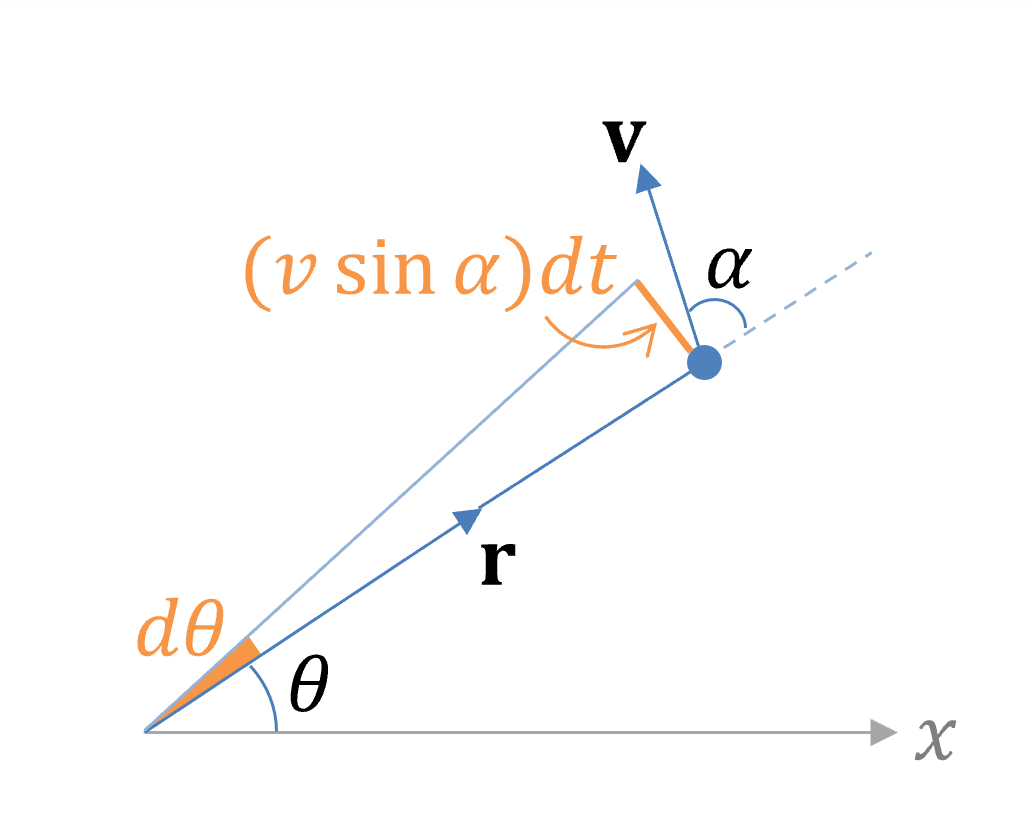
From the diagram above, we see that
v\sin\alpha dt =rd\theta
v\sin\alpha =r\frac{d\theta}{dt}Putting this into the expression for the magnitude of angular momentum, we have
L=mr^{2}\frac{d\theta}{dt}Since Kepler's second law says that
\frac{dA}{dt}=\frac{1}{2}r^{2}\frac{d\theta}{dt}=\text{constant},this implies that
L=2m\frac{dA}{dt}=\text{constant}.